
Your IoT Data Has More Than One Job
Give today's application the data it needs while preserving detail for tomorrow's questions. See how IoT Bridge fans out device data to applications, data lakes, and security systems.

Your IoT Data Has More Than One Job
Every new generation of IoT devices brings more intelligence, more sensors, and more information about the world around us. A single connected product can generate a rich stream of operational, diagnostic, and security data, with value that reaches across the business.
That creates an opportunity that extends well beyond the application the device was originally deployed to support. The same data that helps an operator manage equipment today could help an engineering team improve its efficiency, a quality team investigate a production issue, or a security team recognize unusual behavior.
But those teams can only use the data that is available to them. Decisions made for one application's needs can quietly determine what everyone else will be able to learn later.
The application uses what it needs
IoT applications are built to solve specific problems. They select relevant fields, apply business logic, and turn incoming readings into useful information: a dashboard, an alert, a maintenance ticket, or a utilization report.
Most applications need only a portion of that incoming data. They filter out fields, combine individual readings into summaries, and retain the information relevant to their particular use case. Over time, the original data may be reduced or removed entirely.
For that use case, the decision makes sense. The refined data may provide everything the customer needs while reducing storage, simplifying queries, and keeping the application responsive.
As deployments grow, these decisions become more consequential. More devices, richer data streams, and longer operating histories increase the demands on the main application. Teams choose which data to keep, how much history to retain, and when to replace older detail with broader summaries.
Those choices optimize the application for its job. They also shape the questions its stored data can answer.
Then the next project arrives
Later, a new project needs to ask different questions. An engineering team may want to study product efficiency, or a research team may look for patterns the original application was never designed to explore. The summaries that support everyday operations may lack the detail this work requires.
An investigation may also depend on information that once seemed incidental. Fields excluded from the application's data model, or history aged out of its database, can become essential when the business needs to understand an unexpected problem.
The devices may have already transmitted everything those teams need. Yet if the original application was the only destination, the underlying detail may be gone.
Once original data has been replaced by a summary, the missing detail cannot simply be reconstructed. Each application in a serial chain can narrow the information available to the next, leaving future projects dependent on decisions made for earlier use cases.
The value of data can become clear long after the decision to delete it.
Give the data more than one destination
This is where Tartabit IoT Bridge comes in. Its ability to multiplex device data streams lets you fan out incoming data to multiple destinations, with each receiving the information relevant to its purpose.
The important architectural decision is where that fanout happens: before application-specific processing removes information another destination may need.
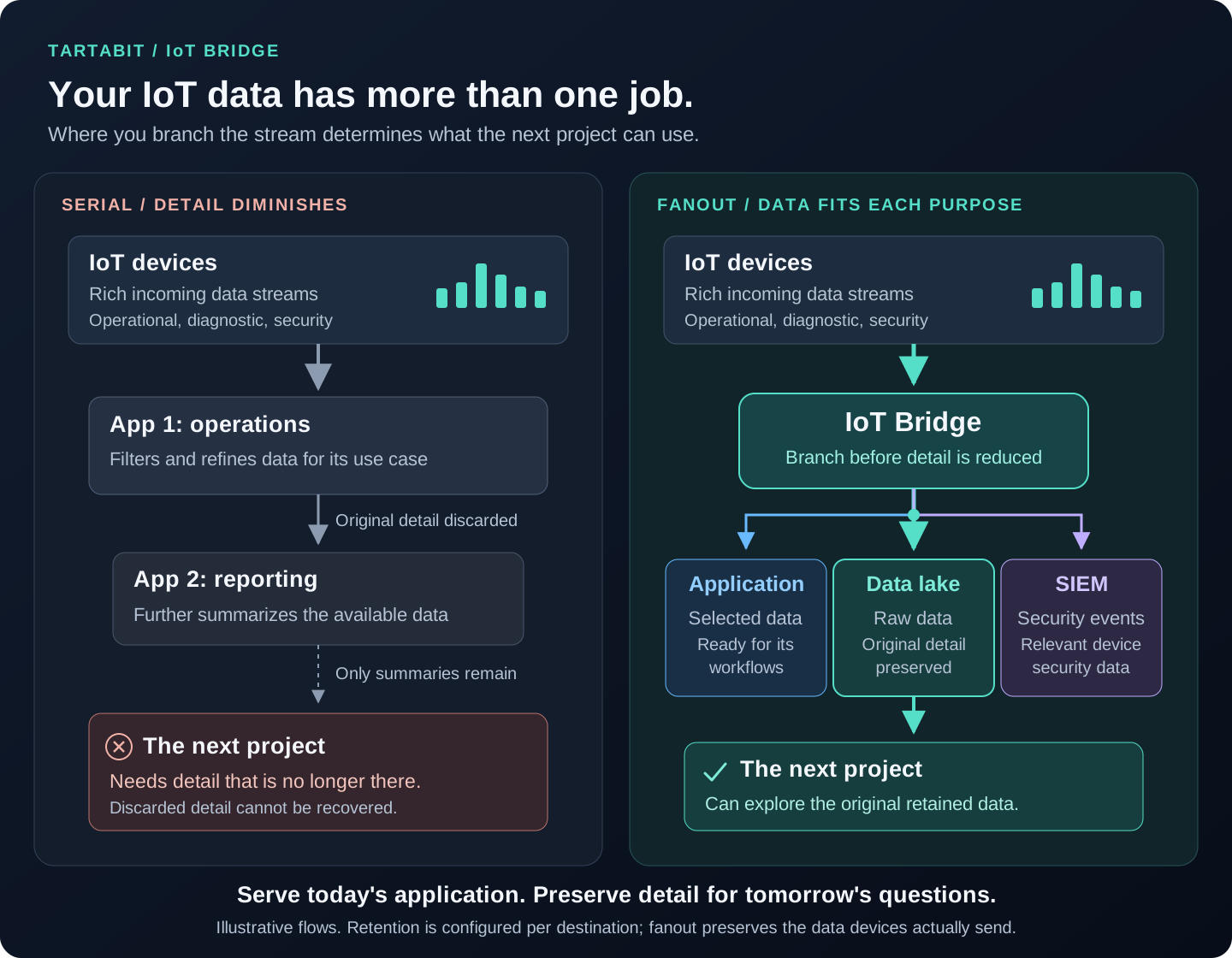
Branch the stream before detail is discarded: each destination receives the data it needs, and future projects can use the original data retained in the lake.
With IoT Bridge, you can build parallel paths from the incoming device stream:
- The operational application receives the selected, decoded, or transformed data required for its workflows. Its own processing and retention policies can stay focused on the use case it serves.
- The data lake receives the raw incoming data for historical analysis, research, and future projects, with storage and retention policies suited to those purposes.
- The security information and event management (SIEM) system receives relevant device security data and events so the security team can examine IoT activity alongside its other enterprise information.
Each destination has a different job. Each can receive an appropriate representation of the same source data.
If the lake is populated only from the application's reduced output, it inherits the application's decisions about what to discard. Sending a separate copy of the incoming data to the lake preserves the detail before that reduction takes place.
One data stream, many uses
The same device deployment can support operations, research, and security at the same time. Through IoT Bridge, each team can receive the data relevant to its work without depending on another application's output.
The operational application can continue refining data for its users. Other teams can work with the richer history retained in the lake, without asking that application to become a research platform or changing its purpose every time a new project appears.
Preserving the context needed to interpret the data makes that history more useful. Future teams need to understand where the information came from and what it represents, as well as have access to the original detail.
Fanout preserves the data the device actually sends. Detail removed before the stream reaches IoT Bridge cannot be recovered downstream, so the choice of where to branch the stream matters.
Keep retention aligned with purpose
Giving raw data a separate destination also gives it a separate lifecycle. The application might keep recent operational detail and longer-term summaries, while the lake retains original incoming data for an agreed research or investigation window. Security data can follow the policies established for the SIEM.
Each path should have a clear purpose, an appropriate retention period, and access controls for the people and systems that use it. Separating those decisions lets teams balance cost and future usefulness without forcing every requirement into the main application database.
It also creates room for the next application. IoT Bridge provides a place to route incoming data to an additional consumer, while an existing archive can supply historical data if it was retained. New projects can build on the same device deployment with their own processing needs.
Your devices already do the work of collecting and transmitting valuable information. IoT Bridge helps put that information to work across the business: the right data to the application, raw data to the lake, and security data to the SIEM.
Talk to Tartabit about making your IoT data available for today's operations and the next project.